
Event Recap
Refugees and Us: Perspectives from International Projects on How Businesses and Individuals Can Act
By 永寓所 Sustalent Hub
On November 3, Sustalent Hub invited Sharlene Chen and Andrew Chen to share international experience in refugee education, employment, energy, and healthcare. Seventy Sustalent Hub community members registered for the gathering, which explored local needs, long-term collaboration, and ways for businesses and individuals to get involved.
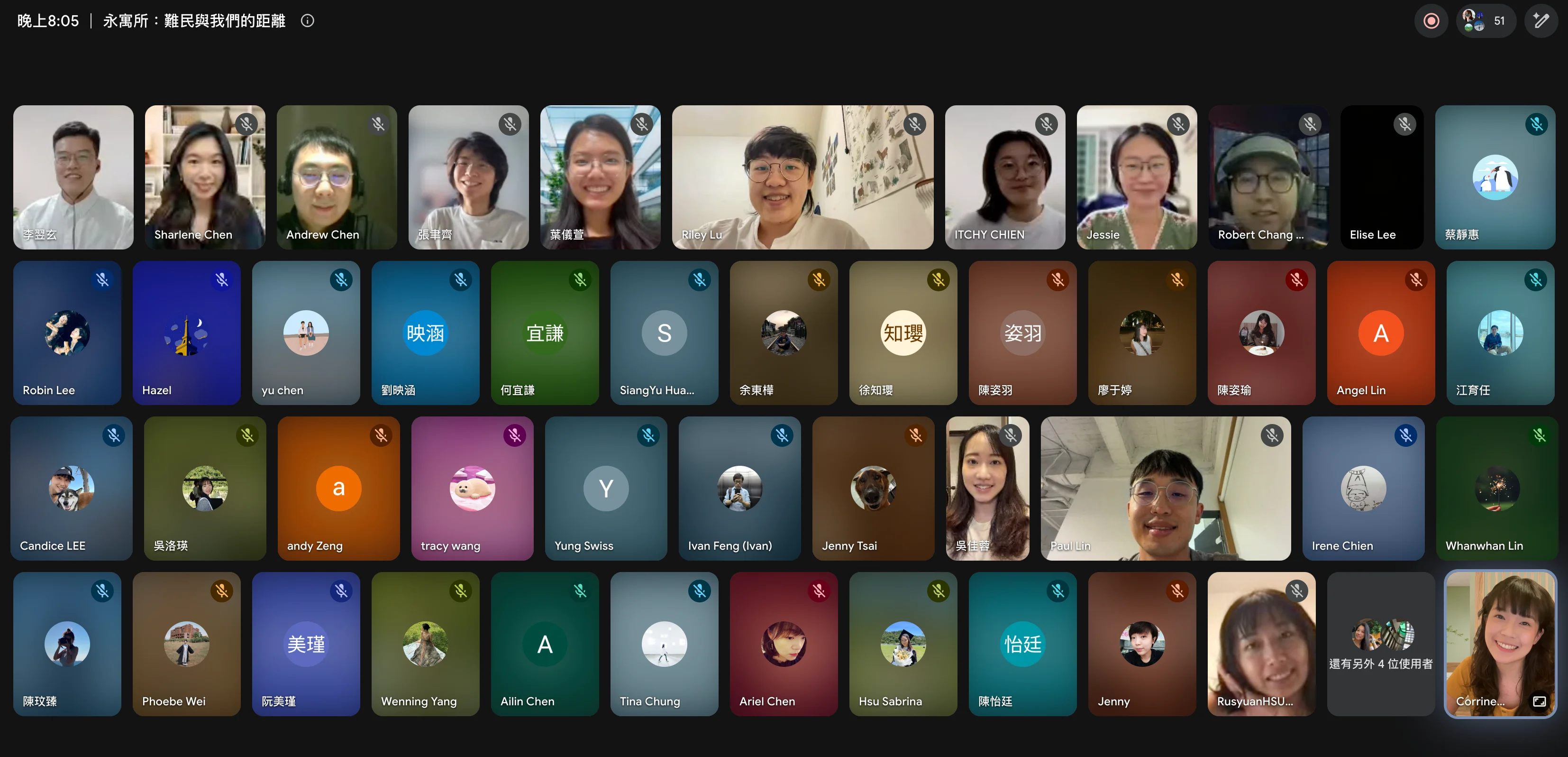
When we talk about sustainability, we often start with the work we know: carbon management, reporting, supply chains, or how businesses respond to new requirements. But beyond that work, we believe there are many issues concerning people's lives, rights, and opportunities that deserve more discussion!
For this gathering, Sustalent Hub invited international development and business and human rights consultant Sharlene Chen and Energy for Refugees project manager Andrew Chen to share the education, employment, and energy projects they have worked on. From online classes for young people from Syria to plans for powering a clinic in the Dominican Republic, the conversation helped us ask a more concrete question: after leaving home, what does a person need to learn, work, and build a life again?
What stands between education and employment?
Sharlene's work spans efforts to combat human trafficking, forced labor, and human rights issues in supply chains. She also continues to take part in the education and skills-building work of the Small School Support Project (SSSP).
SSSP supports school operations, offers classes in English, computer skills, and other subjects, and helps learners find opportunities afterward. Some learners go on to become teaching assistants, teachers, or colleagues within the organization after training. Equipment donated by businesses can also be an important resource for running classes: laptops provided by ASUS, for example, have been used in computer training.
Through online workshops, Sharlene helps young people prepare résumés, use LinkedIn, explore remote work, and keep up with technology news and industry developments. For people whose freedom of movement is restricted and who cannot easily travel to another city or country for work, these classes offer another way to explore career possibilities.
But having classes available does not mean everyone can take part......
A working computer, a way to charge it, reliable electricity, and an internet connection are all prerequisites for online learning. Family and cultural circumstances can also affect participation. Sharlene recalled a female learner who could not continue attending because her family objected to her appearing on camera during video calls.
In one-on-one mentoring, she has also met learners who were once lawyers, doctors, or teachers. After war and displacement, they need time to adjust to changes in their lives and professional identities. Helping them find work again takes more than skills training: it also calls for trust, an understanding of their experiences, and respect for each person's pace.
Reliable electricity is the foundation for learning and healthcare
Sharlene closed her talk by discussing electricity and internet access, which led naturally into Andrew's introduction to Energy for Refugees.
This student-run nonprofit works with schools, clinics, and local groups with limited resources on renewable energy solutions. Andrew explained that the team cannot meet the needs of an entire refugee camp, so it starts with smaller organizations that have clearly defined needs.
In Kakuma, Kenya, a space for learning practical skills already had computers and internet access, but learners still needed reliable electricity to use them consistently. The additional hours made possible by solar power and battery storage can make a real difference to learning and online work.
The project Andrew's team was working on at the time of the event involved partnering with MOSCTHA, a local organization in the Dominican Republic, to plan a solar power and battery storage system for its clinic. The clinic serves migrants of Haitian descent, refugees, stateless people, and other vulnerable groups. Unreliable electricity puts consultations, medical equipment, and refrigerated medicines at risk, and increases the reliance on diesel-generated power.
The project aims to keep essential medical equipment powered as a priority. At the time of the event, the team was still confirming equipment specifications, vendors, and deployment arrangements, while working with the clinic and local suppliers to understand conditions on the ground.
These examples show the direct connection between energy and education, work, and healthcare. When reliable power is unavailable, services and opportunities that are already in place can be interrupted.
Ask what people need before deciding how to help
During the Q&A, a participant raised an important question: when we bring resources and expertise to international projects, how do we avoid assuming we already know what people need?
Andrew said the team had initially considered meeting the clinic's electricity needs for air conditioning. Further discussion revealed that the clinic placed greater priority on power for a new surgical space. The system design therefore had to change to fit the clinic's plans.
That process takes ongoing conversation. The clinic understands the needs of people receiving care, local suppliers know the equipment and installation conditions, and the team brings engineering and project expertise. What each party knows shapes the final solution.
Sharlene also discussed survivor participation in her work to combat human trafficking. In projects she has worked on, survivors or local partners are invited into the discussion at the planning stage to help identify problems and confirm the direction of the work. This reduces the risk of committing resources only to find that the result is difficult to use.
Respect for local needs shows up in concrete decisions: who gets to join the discussion, which needs take priority, and whether the team is willing to change course when its original idea does not fit.
Wanting to help also means knowing your limits
Both speakers also spoke about difficult realities in project work.
Andrew recalled that the team had spoken with groups whose resources were so limited that they had to use the internet time available to them for an entire week just to attend an assessment meeting. Knowing that people needed help while still having to judge whether the team could respond weighed heavily on everyone in the meeting.
Equipment planning involves trade-offs too. Battery storage is important for maintaining power during outages, but it is also one of the more expensive components. With a limited budget, the team has to adjust the specifications while preserving the project's most essential functions as far as possible.
They also hope the partnership will continue after the equipment is delivered. Staff training, data monitoring, and arrangements for local repairs can help keep the system running. Andrew said the team would seek longer warranty and maintenance periods where possible and make further improvements as future needs become clear.
These discussions helped us understand that international collaboration requires repeated assessment, communication, and revision, as well as honesty about what we can do.
Where can businesses and individuals begin?
For businesses, Sharlene suggested first identifying the issues, regions, and groups they want to focus on, along with the resources they can currently offer, before discussing a partnership with an organization.
Equipment, professional training, career mentoring, and remote internships are all possible ways to take part. A good partnership must account for both local needs and what a business can sustain over time.
For individuals interested in international development or human rights work, Sharlene recommended starting with a specific issue they care about, then exploring relevant organizations, volunteer opportunities, internships, research, or short-term collaborations. There is no single path into this work, and existing professional skills may find new applications along the way.
Andrew's own involvement began when he reached out on his own initiative. Although he had missed the recruitment window, he sent the organization a direct message on Instagram to ask whether he could get involved. That message led to their subsequent collaboration.
This is the kind of exchange Sustalent Hub hopes to keep offering: a chance for people to encounter different kinds of work and different issues, meet those already taking action, and find a direction they want to understand better and are able to contribute to.
Thank you to Sharlene, Andrew, and everyone who asked questions and joined the conversation that evening. Their sharing gave us a more concrete understanding of issues affecting refugees, and left us with a question worth continuing to consider: how can our skills and resources respond to the needs people face in different places?
If you enjoy Sustalent Hub's small gatherings on topics like this, or have ideas for future topics, we'd love to hear from you! Email us at: sustalent.hub@gmail.com